Tuesday, 11 December 2018

Memories of the IAVS Symposium in Montana

Yellow columbine (Aquilegia flavescens).
The annual symposium of the International Association for Vegetation Science (IAVS) was held in Bozeman, Montana this year. It was a great pleasure for us and our colleagues to participate in this interesting conference. Our photos and memories have been published in the IAVS Bulletin (here).


The itinerary of the excursions was full with programs through Montana, Idaho and Wyoming, so we shared only some of the most memorable moments. The pre-symposium excursion ‘A’ headed to the Glacier National Park and the Continental Divide. We visited a wide range of habitats, such as western larch and ponderosa pine forests, ancient western red cedar groves, sub-alpine grasslands and prairies. We encountered such scenic landscapes as the Glacier National Park, the Avalanche lake, the Ross Cedar Creek and the Kootenai Waterfalls.
Ross Cedar Creek is a scenic forest of western red cedar (Thuja plicata). Several giant trees are estimated to be older than 1000 years.
Besides the lectures, there were a lot of opportunities for botanising and visiting interesting locations in and near Bozeman during the conference. Definitely, the Museum of the Rockies was one of our favourite. There were ten options for mid-symposium excursions, so it was very difficult to choose from the so many interesting routes. Finally we went to the northern range, just outside the Yellowstone National Park. The tour was very interesting and focused on grasslands on various altitudes with different grazing regimes. We were impressed both by the similarities and differences between the North American and Eurasian dry grasslands regarding their species composition and their role in the whole ecosystem. We also realised that nature conservation problems are quite the same in the grassland habitats of the World. Encroachment of invasive species is an important issue for American nature conservation, however it was really strange to see our common European species (such as Bromus inermis and Poa angustifolia) as problem species in America.

Scenic view in the northern range of the Yellowstone National Park (mid-symposium excursion).
The post-symposium excursion headed to the Beartooth and Yellowstone National Parks. We got a comprehensive overview on the vegetation types of the region, and the role of disturbance in landscape-scale vegetation dynamics. It was very impressive to see the huge, endless forests, where still nowadays fire and grazing are important drivers of vegetation dynamics. We also visited some of the most iconic landmarks of the region, such as the glaciers, hot springs and the Grand Canyon of Yellowstone.

 
Open herb layer in a lodgepole pine stand which burnt two years ago.


Friday, 2 November 2018

Grasslands of Central-Europe - New EDGG Special Feature published in Tuexenia


The 13th EDGG Special Feature in Tuexenia, complements the series of special features devoted to Palaearctic steppes and semi-natural grasslands. It focuses on the conservation, management, restoration and biodiversity of semi-natural and natural grasslands in Central Europe. It was edited by Balázs Deák, Thomas Becker, Steffen Boch and Viktoria Wagner (Deák et al. 2018). Altogether 43 authors from six countries (Bulgaria, Germany, Hungary, Romania, Slovakia, Switzerland and Ukraine) contributed to the published papers. 

The paper of Boch et al. (2018) investigates the effects of grazing management on the species richness of bryophyte species in mesic grasslands. Bódis et al. (2018) studied the habitat preferences of the endangered lizard-orchid Himantoglossum adriaticum. The paper of Bittnerová et al. (2018) deals with the patterns of aboveground vegetation and soil seed bank along a successional gradient from grassland to forest. Didukh & Vasheniak (2018) described the vegetation of limestone outcrops in Podillia (Ukraine). Molnár et al. (2018) studied the factors influencing the distribution of the endangered Sternbergia colchiciflora in grassland habitats preserved in Pannonian cemeteries. Sopotlieva et al. (2018) revealed the ecosystem conditions of Bulgarian grasslands which are located outside of the Natura 2000 network. Szabó & Ruprecht (2018) finally pointed on the potential of seed banks in the recovery of Stipa-dominated and steppe-like dry grasslands. 

The publications are all open access, and freely available from the journal website, from http://www.zobodat.at/publikation_series.php?id=20993 and in the near future also from the re-launched EDGG website. 


Contributions in the Special Feature 


Bittnerová, S., Ujházy, K., Hegedüšová, K., Škodová, I., Ujházyová, M. & Janišová, M. (2018): Soil seed bank and above-ground vegetation changes during grassland succession: Is space-for-time substitution an alternative to re-sampling? Tuexenia 38: 347–370. 

Boch, S., Müller, J., Prati, D. & Fischer, M. (2018): Low-intensity management promotes bryophyte diversity in grasslands. – Tuexenia 38: 311-328. 

Bódis, B., Biró, É., Nagy, T., Takács, A., Molnár V., A. & Lukács, B.A. (2018): Habitat preferences of the rare lizard-orchid Himantoglossum adriaticum H. Baumann. Tuexenia 38: 329–345. 

Deák, B., Becker, T., Boch, S. & Wagner, V. (2018): Conservation, management and restoration of semi-natural and natural grasslands in Central Europe – Editorial to the 13th EDGG Special Feature. Tuexenia 38: 305–310. 

Didukh, Y.P. & Vasheniak, Y.A. (2018): Vegetation of limestone outcrops in Western and Central Podillia (Ukraine). Tuexenia 38: 419–444. 

Molnár V., A., Mészáros, A., Csathó, A.I., Balogh, G., Takács, A., Löki, V., Lovas-Kiss, A., Tökölyi, J., Somlyay, L. & Bauer, N. (2018): Distribution and seed production of the rare, dry grassland specialist Sternbergia colchiciflora (Amaryllidaceae) in Pannonian cemeteries. Tuexenia 38: 371–384. 

Sopotlieva, D., Velev, N., Tsvetkova, N., Vassilev, V. & Apostolova, I. (2018): Ecosystem condition assessment of semi-natural grasslands outside the Natura 2000 network in Bulgaria, using vegetation data. Tuexenia 38: 385–404. 

Szabó, A. & Ruprecht, E. (2018): Restoration possibilities of dry grasslands afforested by pine: the role of seed bank and remnant vegetation. Tuexenia 38: 405–418.

Monday, 29 October 2018

Crane migration – A scenic event of the Hortobágy

The Hortobágy, which is one of the most extended coherent nature close open habitats of Europe is an important part of the migration route of the Cranes nesting in Finland, the Baltic states and Russia. The migrating birds – after having a short break in the Hortobágy – fly towards to North Africa. Interestingly many of the Cranes arrived from Siberia: they made a quite long loop on their way to Africa. This year is an exceptional one with an exceptionally high number of cranes, their estimated number is 160 000.

Opposite to their migration in spring (when the Cranes just fly over the grasslands and wetlands of the Hortobágy) they spend a longer time here in this part of the year. The reason is that whilst in springtime the Cranes primarily focus on reaching the nesting areas as soon as possible, in autumn they have more time for migration. They spend their time in the Hortobágy for increasing their (and their youngsters’) fitness by relaxing a bit and feeding. They spend the nights in the wetlands (generally in the numerous shallow fishponds), and during the daytime they are feeding at the neighbouring arable lands and grasslands. The most scenic part of their daily routine is just before sunset, when they compose huge groups and fly back together to the wetlands for having a night rest.


Feeding in the grasslands of Nyírőlapos-puszta

Waiting for the cranes - spider nets in the sunset; Darassa-puszta

The first ones

Just a small group
  
Early arrivals to the fishpond
  
Cranes in the sunset; Darassa-puszta

Thursday, 18 October 2018

Grassland restoration by seed sowing: when, what and how much?

Our aim is to answer these important questions to support the successful implementation of grassland restoration projects. Choosing the proper timing of seed sowing and the optimal amount and species composition of the sown seed mixtures are very important for maximising restoration success and saving costs.

The matrix of seed mixtures are generally the grass seeds, which have an important role in weed suppression (Deák et al. 2011). Usually they sow the grass seeds in a density of 20-40 kg/ha in the restoration projects. Choosing the right density is crucial: if we don’t sow enough seeds, it can lead to weed encroachment, but sowing too many grass seeds results in the formation of a dense canopy which act as a barrier for the germination of target species via microsite limitation. In large-scale restoration projects, it is not always possible to compose and use a diverse seed mixture in the entire area; thus, they often use low diversity grass seed mixtures. On the one hand, seed sowing of grasses leads to a rapid and predictable vegetation development, and we can expect a species-poor grass-dominated vegetation two or three years after seed sowing (Török et al. 2010, Valkó et al. 2016a). On the other hand, increasing the diversity of these species-poor sown grasslands requires novel methods and a lot of extra work in the future (Valkó et al. 2016b, 2018).

In our project we sowed grass (Festuca rupicola) seeds in 2014 and a diverse seed mixture (containing 20 forb species) in different combinations (together with the grass seeds, and 1, 2 and 3 years later). We study the species composition and functional diversity of the developed communities and evaluate which solution is the best in terms of weed suppression.

Our preliminary results clearly show that the best solution is sowing the diverse seed mixture together with the grass seeds. This treatment resulted in the most diverse vegetation, the lowest level of weed encroachment and the highest number of established target species. In large restoration sites, which are embedded in an agricultural landscape, the spontaneous establishment of target species is very unlikely, given their impoverished seed banks and the lack of propagule sources. In such areas, active introduction of target species is inevitable for restoring species-rich grasslands. Our results suggest that it is a much more practical and cost-effective solution to sow the diverse seed mixture together with the grass seeds, at the very first stage of grassland restoration.

Here are some pictures about the experiment in October 2018.

In this plot, the diverse seed mixture and the grass seeds were sown in the same year (2014).

Here we sowed the diverse seed mixtures in 2015, i.e. 1 year after the grass seeds (2014).

Here we sowed the diverse seed mixtures in 2016, i.e. 2 years after the grass seeds (2014).

Here we sowed the diverse seed mixtures in 2017, i.e. 3 years after the grass seeds (2014).
Literature Cited

Deák, B., Valkó, O., Kelemen, A., Török, P. Miglécz, T., Ölvedi, T., Lengyel, Sz., Tóthmérész, B. 2011: Litter and graminoid biomass accumulation suppresses weedy forbs in grassland restoration. Plant Biosystems 145: 730-737.

Török, P., Deák, B., Vida, E., Valkó, O., Lengyel, Sz., Tóthmérész, B. 2010: Restoring grassland biodiversity: Sowing low-diversity seed mixtures can lead to rapid favourable changes. Biological Conservation 143: 806-812.

Valkó, O., Tóth, K., Kelemen, A., Miglécz, T., Radócz, S., Sonkoly, J., Tóthmérész, B., Török, P., Deák, B. (2018): Cultural heritage and biodiversity conservation – Plant introduction and practical restoration on ancient burial mounds. Nature Conservation 24:65-80.
Valkó, O., Deák, B., Török, P., Kelemen, A., Miglécz, T., Tóth, K., Tóthmérész, B. 2016a: Abandonment of croplands: problem or chance for grassland restoration? Case studies from Hungary. Ecosystem Health and Sustainability 2(2): e01208.

Valkó O., Deák B., Török P., Kirmer A., Tishew S., Kelemen A., Tóth K., Miglécz T., Radócz Sz., Sonkoly J., Tóth E., Kiss R., Kapocsi I., Tóthmérész B. 2016b: High-diversity sowing in establishment gaps: a promising new tool for enhancing grassland biodiversity. Tuexenia 36: 359-378.

Sunday, 7 October 2018

Filming

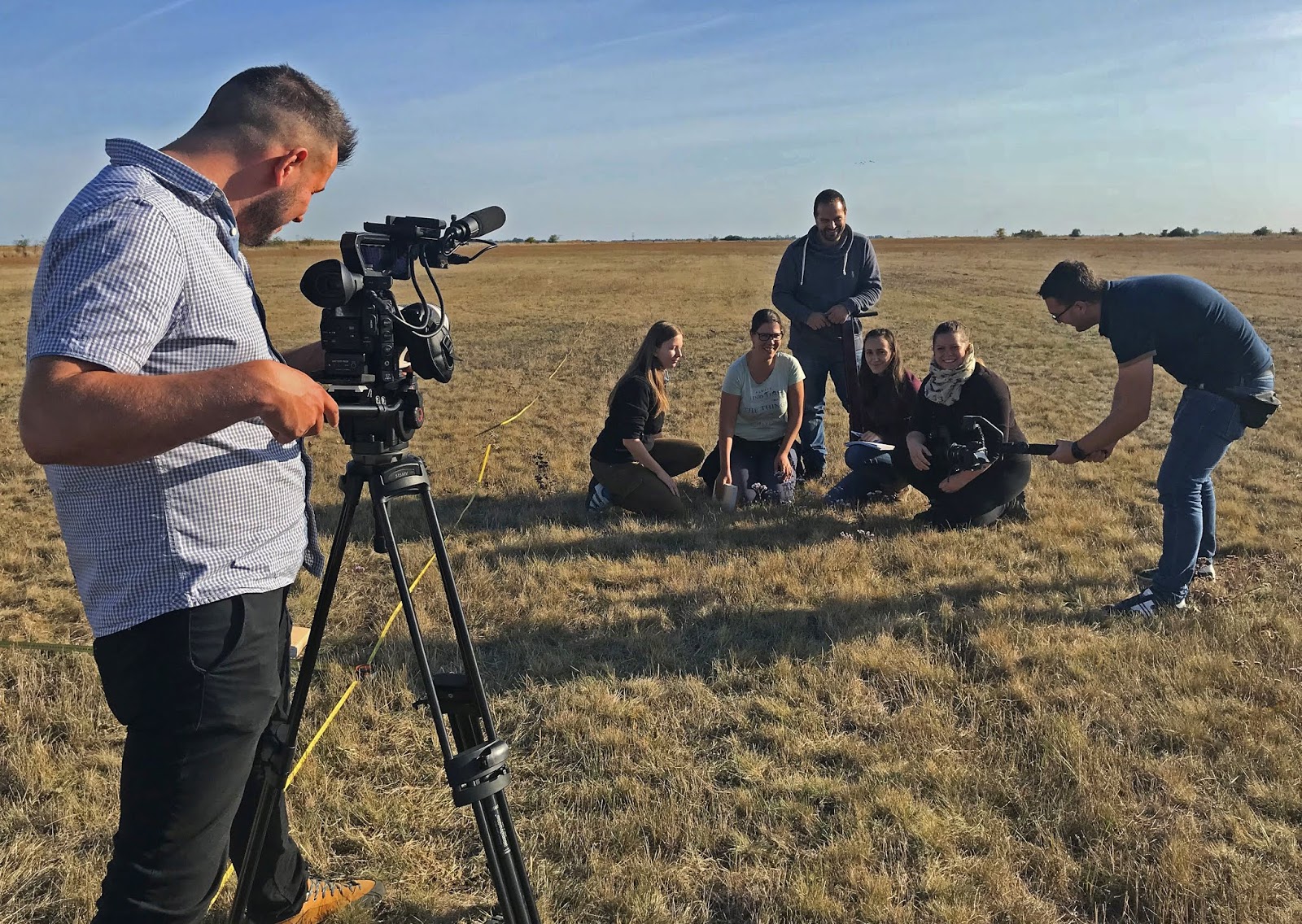
This week we made a project video about the work in the Department of Ecology, University of Debrecen. The main aim of the film is to provide an overview on the life in the Department, on our research topics and showing the ‘essence of being an ecologist’ to the students. During the filming we had a ‘field action’ scene in the Hortobágy, one in the greenhouse, one in the lab and many others. I think that with the help of the Médiacentrum Debrecen we managed to make an exciting ‘movie’. 

The film will be ready in December. Till then some werk fotos.


Monday, 1 October 2018

PhD defense, Réka Kiss

I am happy to congratulate to my former PhD student, Réka Kiss who successfully (indeed, very succesfully, with summa cum laude) defended her PhD thesis recently.

Réka has been studying the role of seed bank and seed sowing in grassland restoration. She presented the key results of two novel and interesting research topics: 1, her literature review about the links between seed bank, climate change and restoration prospects in the open landscapes in the World and 2, establishment gaps, a novel tool for the restoration of species-rich grasslands.

The most important publications related to her dissertation are as follows

Kiss, R., Deák, B., Török, P., Tóthmérész, B.., Valkó, O. (2018) Grasslands and climate change – How can soil seed bank support community resilience? Restoration Ecology, 26, S141-S150.

Kiss, R., Sonkoly, J., Török, P., Tóthmérész, B., Deák, B., Tóth, K., Lukács, K., Godó, L., Kelemen, A., Miglécz, T., Radócz, Sz., Tóth, E., Balogh, N., Valkó, O. (2018) Germination capacity of 75 herbaceous species of the Pannonian flora and implications for restoration. Acta Botanica Hungarica, 60, 357-368.

Kiss, R., Valkó, O., Tóthmérész, B., Török, P. (2016) Seed bank research in Central-European grasslands - An overview. In: Murphy, J. (ed.) Seed Banks: Types, Roles and Research, Nova Science Publishers, 1-34.

Kiss, R. (2016) The role of soil seed bank in restoration and dynamics of Hungarian plant communities – A review of Hungarian seed bank research . Kitaibelia, 21, 116-135.

Valkó, O., Deák, B., Török, P., Kirmer, A., Tishew, S., Kelemen, A., Tóth, K., Miglécz, T., Radócz, Sz., Sonkoly, J., Tóth, E., Kiss, R., Kapocsi, I., Tóthmérész, B. (2016) High-diversity sowing in establishment windows: a promising new tool for enhancing grassland biodiversity. Tuexenia, 36, 359-378.

Török, P., Kelemen, A., Valkó, O., Miglécz, T., Tóth, K., Tóth, E., Sonkoly, J., Kiss, R., Csecserits, A., Rédei, T., Deák, B., Szűcs, P., Varga, N., Tóthmérész, B. (2017) Succession in soil seed banks and its implications for restoration of calcareous sand grasslands. Restoration Ecology, 26, S134-S140.

Godó, L., Tóthmérész, B., Valkó, O., Tóth, K., Kiss, R., Radócz, Sz., Kelemen, A., Török, P., Švamberková, E., Deák, B. (2018) Ecosystem engineering by foxes is mediated by isolation in grassland fragments. Ecology and Evolution, 8, 7044-7054.

We would like to congratulate Réka with some nice and memorable photos, taken in our favorite field days. :)