Wednesday, 21 July 2021

Wildland fire in Europe: an overview and national perspectives

The members of the FireLink Cost Action compiled a synthesis paper, where we give an overview of the current wildland fire patterns across Europe and highlight the most important overarching challenges. The authors from 31 countries also provide national perspectives, where we report on the trends, major research direrections and the hottest issues in their respective home countries. From Hungary, four researchers from the Centre for Ecological Research participated: Miklós Kertész, Orsolya Valkó, Balázs Deák and Réka Aszalós.

The paper is open acceses and can be freely downloaded from the homepage of the Air, Soil and Water Research journal.


Abstract

Changes in climate, land use, and land management impact the occurrence and severity of wildland fires in many parts of the world. This is particularly evident in Europe, where ongoing changes in land use have strongly modified fire patterns over the last decades. Although satellite data by the European Forest Fire Information System provide large-scale wildland fire statistics across European countries, there is still a crucial need to collect and summarize in-depth local analysis and understanding of the wildland fire condition and associated challenges across Europe. This article aims to provide a general overview of the current wildland fire patterns and challenges as perceived by national representatives, supplemented by national fire statistics (2009–2018) across Europe. For each of the 31 countries included, we present a perspective authored by scientists or practitioners from each respective country, representing a wide range of disciplines and cultural backgrounds. The authors were selected from members of the COST Action “Fire and the Earth System: Science & Society” funded by the European Commission with the aim to share knowledge and improve communication about wildland fire. Where relevant, a brief overview of key studies, particular wildland fire challenges a country is facing, and an overview of notable recent fire events are also presented. Key perceived challenges included (1) the lack of consistent and detailed records for wildland fire events, within and across countries, (2) an increase in wildland fires that pose a risk to properties and human life due to high population densities and sprawl into forested regions, and (3) the view that, irrespective of changes in management, climate change is likely to increase the frequency and impact of wildland fires in the coming decades. Addressing challenge (1) will not only be valuable in advancing national and pan-European wildland fire management strategies, but also in evaluating perceptions (2) and (3) against more robust quantitative evidence.

The citation of the paper:

Fernandez-Anez, N., Krasovskiy, A., Müller, M., Vacik, H., Baetens, J., Hukić, E., Kapovic Solomun, M., Atanassova, I., Glushkova, M., Bogunović, I., Fajković, H., Djuma, H., Boustras, G., Adámek, M., Devetter, M., Hrabalikova, M., Huska, D., Martínez Barroso, P., Vaverková. M.D., Zum, D., Jõgiste, K., Metslaid, M., Koster, K., Köster. E., Pumpanen, J., Ribeiro-Kumara, C., Di Prima, S., Pastor, A., Rumpel, C., Seeger, M., Daliakopoulos,, I., Daskalakou, E., Koutroulis, A., Papadopoulou, Maria P., Stampoulidis, K., Xanthopoulos, G., Aszalós, R., Deák, B., Kertész, M., Valkó, O., Finger, D.C., Thorsteinsson, T., TilL, J., Bajocco, S., Gelsomino, A., Minervino Amodio, A., Novara, A., Salvati, L., Telesca, L., Ursino, N., Jansons, A., Kitenberga, M., Stivrins, N., Brazaitis, G., Marozas, V., Cojocaru, O., Gumeniuc, I., Sfecla, V., Imeson, A., Veraverbeke, S., Fjellgaard Mikalsen, R., Koda, E., Osinski, P., Meira Castro, A.C., Nunes, J.P., Oom, D., Vieira, D., Rusu, T., Bojović, S., Djordjevic, D., Popovic, Z., Protic, M., Sakan, S., Glasa, J., Kacikova, D., Lichner, L., Majlingova, A., Vido, J., Ferk, M., Tičar, J., Zorn, M., Zupanc, V., Hinojosa, M.B., Knicker, H., Lucas-Borja, M.E., Pausas, J., Prat-Guitart, N., Ubeda, X., Vilar, L., Destouni, G., Ghajarnia, N., Kalantari, Z., Seifollahi-Aghmiuni, S., Dindaroglu, T., Yakupoglu, T., Smith, T., Doerr, S., Cerda, A. (2021): Current wildland fire patterns and challenges in Europe: A synthesis of national perspectives. Air, Soil and Water Research 14: 1-19. doi: 10.1177/11786221211028185

Friday, 16 July 2021

Beauties of European grasslands

A wonderful photo book 'Life on European Grasslands' about the natural beauties of European Grasslands has recently been published by the Super-G Team. 

We participated in the book with a few photos. Balázs was awarded by the First Place in the category 'Outdoor Recreation'. To illustrate the beauty of the grasslands, please see below the photos from us which were included in this wonderful book.

'If you have good company, you don't need a smartphone to have fun' - Plovdiv region, Bulgaria - category winner photo by Balázs Deák

'Sea of flowers in an agricultural landscape' - Legyesbénye, Hungary - photo by Balázs Deák

'Nature and culture: Grassland on an ancient burial mound is used today as a pasture' - Tiszafüred, Hungary - photo by Balázs Deák

'A landscape created by traditional land use' - Gyimes, East-Carpathians - photo by Balázs Deák

'Natural and cultural heritage maintained by animal husbandry' - Hortobágy National Park, Great Hungarian Plain - photo by Orsolya Valkó

'First flowers of the spring' - Apuseni National Park - photo by Orsolya Valkó


Monday, 12 July 2021

Zoochory on/off: A field experiment and our new paper in Journal of Vegetation Science

We have recently published a paper about the relative importance of zoochory compared to other effects of grazing livestock.

The citation of the paper is

Kiss, R., Deák, B., Tóthmérész, B., Miglécz, T., Tóth, K., Török, P., Lukács, K., Godó, L., Körmöczi, Z., Radócz, S., Borza, S., Kelemen, A., Sonkoly, J., Kirmer, A., Tischew, S., Valkó, O. (2021): Zoochory on and off: A field experiment for trait-based analysis of establishment success of grassland species. Journal of Vegetation Science 32: e13051. doi: 10.1111/JVS.13051 [IF2020: 2.685]

The paper is open access and can be downloaded from here. 

Cattle are very important drivers of vegetation dynamics.

Grazing livestock play a central role in the vegetation dynamics of grasslands. They alter microsite availability by grazing, trampling and manuring and they are important zoochorous vectors for the propagules of many plant species. These complex effects of livestock on the vegetation are seldom studied separately, so our knowledge on the relative importance of the processes is still incomplete.

In our controlled field experiment, our aim was to study the process of zoochorous dispersal separately from all other potential effects of livestock. You can see below our experimental design: we introduced propagules of 35 grassland species into source plots located in six species-poor restored grasslands (where the sown species were absent). One of the source plots were fenced, while the other one and the whole are of the pastures was grazed by cattle. We monitored the dispersal of the sown species from the source plots to the surroundings for three years in a total of 960 plots. From the fenced plots, we could exclude the possibility that the propagules of sown species can be dispersed by cattle ('Zoochory Off' setting), while from the grazed source plots, the propagules could be dispersed by the livestock ('Zoochory On' setting). All the other effects of livestock (trampling, grazing, manuring) were rather uniformly distributed accross the pasture, so we could assume that the presence or abscence of a sown species in the dispersal plots were most probably driven by the type of the source plot, i.e. whether zoochory was on or off.

Our sampling design showing the grazed areas (the whole pasture + the grazed source plot), the fenced source plot and the dispersal plots organized in transects.

Species- and flower-rich source plot located in the species-poor restored grassland.

Although grazing reduced the cover and flowering success of sown species in the source plots, the number of successful establishment events was higher in dispersal plots next to grazed source plots. The sown species were the most abundant in plots adjacent to source plots, but occurred in all monitored distances. Zoochory favoured perennial plants with high specific leaf area, low leaf dry matter content, short stature, light seeds, early flowering period, high clonal index and anemochory index.

The differences in trait composition of the vegetation under the ‘zoochory on’ and ’zoochory off’ settings highlight the importance of grazing in our study system. We showed that depending on the presence or absence of zoochory plant species with contrasting traits can colonize the surrounding homogeneous matrix. Communities that developed under zoochory were characterized by traits that are adaptive under grazed conditions, while communities that could not communicate with the source plots via zoochory were functionally different. This suggests a strong link of traits favouring zoochory and those supporting the survival of plants under grazed conditions.

In grazing-adapted ecosystems, fencing source populations of target species does not always seem to be a good option. We found that fencing increased the cover and flowering success of the sown species in the short run, but it significantly decreased their chance to colonize the surrounding area. Another negative effect of fencing in the long run is the accumulation of litter and related decrease in species richness. These problems might be overcome by targeted management of the fenced patches by mowing or by using mobile fences that can be temporarily removed, however, these practices should be tested in future studies. We suggest that in conservation and restoration projects fencing should be applied when the priority is the protection of a source population, however, when the goal is to facilitate the spread of target species, fencing is probably not a favourable option.


Abstract

Aims: We tested the establishment success of grassland species in the presence or absence of zoochory by livestock and identified the traits associated with successful establishment.

Location: Hortobágy National Park, Hungary.

Methods: In six restored species-poor grasslands we established two species-rich 16 m2-sized source plots per site in 2013. One source plot was managed by extensive cattle grazing (’zoochory on’), the other one was fenced and protected from grazers (’zoochory off’). We monitored the vegetation development in the source plots (2014-2018), and the establishment success of sown species (2016-2018) in adjacent dispersal plots in four, 20-m-long strips per source plot; in a total of 960 dispersal plots. We calculated community weighted means of thirteen plant traits related to regeneration and competitive ability. The effect of grazing, year, distance from source plots, grazing:year and grazing:distance interactions on population and trait-dynamics in the source and dispersal plots were analysed with generalized linear mixed-effect models.

Results: Although grazing reduced the cover and flowering success of sown species in the source plots, the number of successful establishment events was higher in dispersal plots next to grazed source plots. The sown species were the most abundant in plots adjacent to source plots, but occurred in all monitored distances. Zoochory favoured perennial plants with high SLA, low LDMC, short stature, light seeds, early flowering period, high clonal index and anemochory index.

Conclusions: We showed that species that can colonize the matrix with and without zoochory have contrasting trait syndromes. In grazing-adapted ecosystems, fencing source populations of target species does not always seem to be a good option. It was a good tool for increasing the cover and flowering success of the sown species in the short run, but it significantly decreased their chance to colonize the surrounding area in the long run.

Friday, 23 April 2021

How could prescribed burning contribute to grassland conservation in Europe? Our new review paper has been published


Our invited review paper about the applicability of prescribed burning for the conservation of European grasslands has recently been published in Current Opinion in Environmental Sustainability and Health.

The citation of the paper is

Valkó, O., Deák, B. (2021): Increasing the potential of prescribed burning for the biodiversity conservation of European grasslands. Current Opinion in Environmental Sustainability & Health doi: 10.1016/j.coesh.2021.100268

The paper is open access, please click here to download.

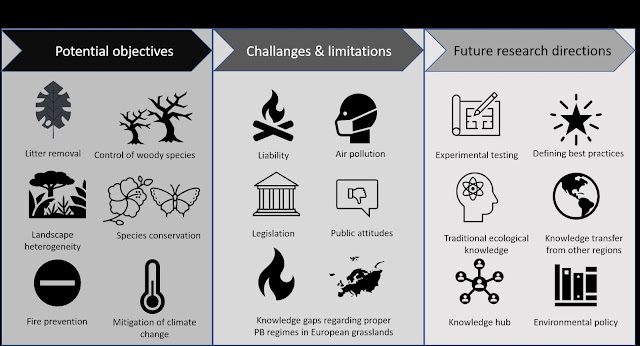
Our aim was to summarize the knowledge related to the applicability of prescribed burning as a potential conservation tool in European grasslands. Prescribed burning (PB) means a carefully planned and executed application of fire in order to reach a specific management objective. In many fire-prone ecosystems, such as the South American cerrado, the South African fynbos or the North American prairies, PB practices are integral elements of conservation and restoration projects aiming to increase the biodiversity in open landscapes. Contrary, in Europe, most PB projects are related to forest ecosystems and shrublands. We found that there were only a few dozens of experimental PB studies in European grasslands, and the large-scale application of prescribed fire is even more scarce. It would be important to gain knowledge about this cost-effective conservation measure, as based on studies from other continents or ecosystems, PB might be a feasible tool to address conservation problems, such as abandonment, intensification, invasive species and climate change.


Our review emphasises that the currently available knowledge about PB effects in European grasslands is not sufficient to completely evaluate its applicability. In most experiments PB was applied in small plots, resulting in homogeneous fire patterns different from wildfires. None of the European experiments applied natural-like fire regimes, but used two approaches instead: either yearly burning of the same parcels for many years or testing the effect of a single PB event. The first approach does not resemble natural fire regimes and does not allow the regeneration of the vegetation between burns. The second approach often had more promising results, as single PB can have favorable short-term effects, but those are less persistent than in case of a complex fire regime with well-suited fire return intervals.

We suggest that the adaptation of the fire regime concept would considerably increase the practical applicability of the findings of future PB experiments in grassland conservation. The use of sophisticated fire regimes matched to the local site conditions could considerably increase the effectiveness of PB to achieve certain conservation goals. It is important to determine optimal PB regimes based on experimental approaches, paleo-data and traditional ecological knowledge, and incorporate the findings also into the legislation.

We also proposed a decision support framework, which can be applied in the planning phase of PB regimes for evaluating the risks and available knowledge related to the application of PB in a particular site for solving a particular problem. Application is suggested only in those cases when all the potential risks can be controlled based on available knowledge. When it is not possible, further studies are needed before PB application.

Decision support framework for evaluating the risks, benefits and available knowledge related to the application of PB in a particular site for solving a particular problem. Based on the answers to the questions (Q1-4) four alternative decisions (D1-4) exist on the applicability of PB in a certain site. In case of knowledge gaps, we list the most important future research directions (R1-4).

Please find below the abstract and graphical abstract of the paper.

Abstract

Prescribed burning (PB), the planned and controlled application of fire is a well-established tool for biodiversity conservation in a plethora of habitats globally. In European grasslands that are threatened hotspots of biodiversity, PB has the potential to address challenges related to several threats such as abandonment, climate change or invasive species. However, its potential is seldom realized both in experimental and real-world conditions. To increase the potential of PB in the management of European grasslands, we suggest adapting the fire regime concept in future studies and to determine optimal PB regimes based on experimental approaches, paleo-data and the disappearing traditional ecological knowledge. For the evidence-based evaluation of PB applicability, a decision support framework is suggested.
 

Monday, 5 April 2021

Study on human-vectored seed dispersal: Germination expriment started

One of our favourite research topics is the study of human-vectored seed dispersal. We would like to understand what role do we humans play in the unintentional dispersal of propagules during our everyday life.

The PhD topic of Katalin Lukács is the experimental study of human-vectored seed dispersal. During the past two years, Kata coordinated a field experiment, where she investigated the outdoor movement of volunteers in the field - the volunteer participants included field biologists and hikers - and collected the propagules from their footwear and socks after their outdoor walks. We will correlate the amount and species composition of the dispersed propagules to a range of habitat, landscape and vector-related factors. The first phase of sample processing was the sorting of the more than 35,000 collected propagules. In the next phase, we will test the viability of the propagules and identify them in a large germination experiment. The work of Kata was awarded by the Universitas Foundation of the University of Debrecen - congratulations!

Katalin Lukács, Réka Kiss, Ágnes Tóth and András Kelemen have recently started the germination experiment - now we are looking forward the results :) Please see below some pictures about the preparation works in this nice early spring weather.


Tuesday, 16 March 2021

Spring, finally :) Monitoring of the spring meadow saffron

Finally, spring has arrived. This is the time of our first annual census of the spring meadow saffron population that we have been monitoring since 2018. This year  Réka Kiss, Laura Godó and Katalin Lukács performed the monitoring.

In the project coordinated by Réka Kiss, we focus on the population dynamics of the spring meadow saffron (Bulbocodium vernum), an early spring geophyte species marked as ‘Vulnerable’ in the Carpathian Basin and ‘Critically Endangered’ in Hungary. Being one of the first flowering plants in spring, in the past it was intensively collected; this fact together with the destruction of its natural habitats resulted in the severe decline and in some cases extinction of its populations. Human-mediated and natural processes, as well as climatic changes further threaten the survival of the species in Hungary. In the project we monitor the population dynamics of the spring meadow saffron, and correlate it with climatic parameters, in order to understand the effect of climatic changes on the populations. The results can contribute to the protection of this endangered species.

Please find below some pictures about this beautiful plant, taken by Laura Godó.