Wednesday, 8 December 2021

New projects targeting public outreach and dissemination


Four projects from our research group received funding in the 'Scientific Mecenatura' call of the National Research, Development and Innovation Office. The call targets to support public outreach and dissemination activities and citizen science projects.

We are very happy that thanks to this funding, we will be able to continue and upscale our project that aims to support the use of native flowering plant species in home gardens instead of non-native, potentially invasive alternatives.

NKFI MEC_N 140750  Nature at home: Supporting native plant species in urban gardens

The mission of our project is environmental education by dissemination of knowledge, the practical involvement of participants and the analysis of social attitudes. Our project aims to bring nature closer to people, as a number of new researches prove that a greener environment contributes to maintaining our physical and mental health. It is also becoming more and more fashionable to decorate homes and courtyards of institutions with plants and flowers. We want to reach people through this ’fashion’ and offer a nature-friendly alternative, that is, we can also decorate our environment with native plants. Our project offers a good challenge or a playful task for almost all people with any area of interest, regardless of age, or even a new hobby. We offer the seeds of native flowering plants from which people can choose and plant them at home. This way the participants can get one step closer to a nature-friendly home, kindergarten or school yard. Our target group is wide, anyone from the preschool age can get involved and do something for nature conservation with their own hands. We create information and display materials which will be available online and in print. We create a website with useful functions and a short film which will be available on the YouTube video sharing website. We also create a promotional and news-sharing page on the Facebook social media website. Project participants receive a printed brochure containing all the necessary information. We provide the opportunity for personal meeting and contact; we also present our project in stands at nature- and environmental conservation events and in ‘green tents’ of festivals. An attention-grabbing molino is made for these events. We present our project in environmental and biology classes in primary and secondary schools. We ask the participants to fill in an anonymous questionnaire and ask for feedback on the results of the planting and the experiences. With the help of the questionnaire and the feedback, we can improve our project in the future, as it can shed light on the social attitude and on the criteria for choosing an ‘ornamental plant’. Our project is a good opportunity to combine an increasingly popular hobby, gardening, with nature conservation. It provides an opportunity for enthusiastic participants to collaborate, build a community, share experiences and support each other. For children – one of our main target groups – it can even serve as a school task to create a small garden at home or in the school yard and to follow and observe the development of the plants.

Our goal is to spread the word about the use of native flowering plants instead of non-native and potentially invasive alternatives in home gardens.

The project participants: Laura Godó (the main coordinator of the project), Orsolya Valkó (principal investigator), and we receive a lot of help from project participants: Katalin Lukács, Réka Kiss, Sándor Borza, Balázs Deák.

We will regularly give project updates here and elsewhere in the future :)

Besides this big project, three members of our research group also received funding for the communication of their results and presentation at international conferences:

Sándor Borza, MEC_R_141154: The common crane (Grus grus), an ecosystem engineer in dry grasslands

Soil disturbance by the common crane (the so-called 'crane-ploughing') creates distinct vegetation patches in alkaline grasslands.

Laura Godó, MEC_R_141151: Secondary seed dispersal by the Barn Owl (Tyto alba) in open habitats

Via diploendozoochory, a bird of prey, such as the Barn Owl can also contribute to the dispersal of plant propagules.


Katalin Lukács, MEC_R_141156: The role of humans in seed dispersal

During outdoor activities, we can unintendedly disperse a large amount of plant propagules on our clothes and footwear.


Saturday, 27 November 2021

Book about the biodiversity preserved by kurgans

In the past years I have published two books (one in English and one in Hungarian) about the natural and cultural values associated with ancient burial mounds (kurgans). From the Hungarian book approximately 800 free books were provided to conservation agencies, farmers, researchers, schools and universities. In order to spread the word about the importance of kurgan protection to everyone interested, I decided to make the electronic version of both books freely available to everyone interested. The pdfs of the two books and some other related publications can be downloaded using this link: 


Sunday, 14 November 2021

Extinction debt in grassland islands embedded in agricultural landscapes

In our recently published paper we studied the effect of historical landscape changes on plant and arthropod communities harboured by grassland habitat islands.

Deák, B., Bede, Á., Rádai, Z., Tóthmérész, B., Török, P., Nagy, D.D., Torma, A., Lőrinczi, G., Nagy, A., Mizser, S., Kelemen, A., Valkó, O. (2021): Different extinction debts among plants and arthropods after loss of grassland amount and connectivity. Biological Conservation 264: 109372. doi: 10.1016/j.biocon.2021.109372.

The paper is open access and can be freely downloaded from here. 

Loss and fragmentation of natural and semi-natural habitats pose a major threat for biodiversity worldwide. Their effect are often coupled with additional effects (such as altered abiotic conditions, abandonment, invasion of plant and animal species) that lead to the degradation of the habitat, which on the one hand threatens the survival and reproduction of habitat specialist species and on the other hand supports the establishment of generalists. Habitat loss, fragmentation and degradation often lead to a decrease in population size and fitness of habitat specialist species that can finally result in the local extinction of area- and disturbance-sensitive species. However, such extinction processes are not necessarily immediate. Many populations show a delayed extinction causing an 'extinction debt' that is typical of recently fragmented landscapes in which the area and/or the spatial configuration of the habitat fragments are just below the extinction threshold for certain species. Existence of extinction debt can be assumed when the characteristics of the past landscape explain current species richness better than the characteristics of the present landscape.

In our study we aimed to explore the temporal dimensions of extinction debt across plant and arthropod taxa (ants, orthopterans, true bugs and rove beetles) in grassland habitat islands embedded in agricultural landscapes. We related the species richness of habitat specialist and generalist species to the current and past landscape metrics referring to the total grassland area and patch connectivity in the surroundings of the focal patch. We collected data from 60 dry focal grassland fragments (situated on ancient burial mounds so called 'kurgans'). Our study covered a period of 158 years including four time periods.

Grassland habitat island on an ancient burial mound.

Grassland habitat island on an ancient burial mound.

We hypothesised that (i) historical landscape factors explain the current species richness of habitat specialists more than that of generalists, (ii) habitat connectivity has a larger effect on specialist species than habitat amount and (iii) area and environmental heterogeneity of the focal grassland patch increase the relaxation time of specialists whereas encroachment of woody species decreases it.


Map of the surveyed grassland fragments (n = 60). Changes in the grassland cover around one of the studied focal habitat patches over time: B – (1858–1864), C – (1881–1884), D – (1956–1975), E – (2014–2016).

We found that in the study area the amount of dry grasslands has been declining constantly from the 1850s until present days. Interestingly, the constant loss of habitats during the four studied periods did not result in a significant loss of habitat connectivity for an extended time interval during the first three periods (from 1858 to 1975). Even habitat loss accelerated after the WW II, the still existing network of farms and the related heterogeneous land use system with the many small grassland fragments could hinder the loss of connectivity. Habitat loss was severe in the later phase of the communist era and during the change of regime in the 1990s when crop monocultures appeared.


Effect of grassland amount and connectivity on the species richness of specialist (green dots) and generalist (grey dots) plant species in Periods III–IV. Solid lines represent significant, dashed lines non-significant relationships.

In our study sites current species richness of specialist plants correlated stronger with grassland amount and connectivity typical to the landscape five to seven decades ago than with present landscape characteristics. And the effect of past grassland connectivity was larger on specialist plants than the effect of past grassland amount, likely because loss of connectivity in recent times had more severe effect on the functional connections of remaining populations. The fact that the populations of specialist plants in the focal habitat patches still have not come to equilibrium with the attributes of the present landscape suggests that further extinctions can be expected especially in the case of specialist species sensitive to the loss of metapopulation connections. The reason for the long relaxation time is that in general, plants as sessile organisms react slowly to changes in the neighbouring landscapes and in local conditions. Traits typical to many plant species such as long life-span, ability for clonal reproduction, possession of seed banks can support the long time survival of plant species even under altered environmental conditions leading to a considerable time lag between the changes in landscape changes and changes in the species composition of specialist plant assemblies.

Interestingly high slope inclination that is a good proxy for high environmental heterogeneity (see also in Deák et al. 2021 Science of the Total Environment), had a significant positive effect on the species richness of specialist plants and assumed to mitigate extinction process (and increased time lag). The reason for that might be that high environmental heterogeneity expressed in topographic, micro-climatic heterogeneity and heterogeneity in soil properties can also increase the chance for the long-term persistence of plants within the focal grassland patch since even short distance disperser plant species can achieve short shifts within the focal habitat to establish in the microsite that is edaphically and climatically most favourable for them.

In contrast to specialist plants, the species richness of the studied specialist animal taxa (ants, orthopterans, true bugs and rove beetles) was not related to grassland amount or connectivity; thus, they were either unaffected by landscape changes or have already paid their extinction debt induced by landscape transformations in the past. The reason for that is despite plants, animals can actively disperse and leave habitats that have become unsuitable due to unfavourable changes. However, when animals are not able to relocate to another suitable habitat patch, local extinction processes might be much faster for them because of their short life cycles and high sensitivity to the lack of metapopulation connections.

However, the fact that dry grassland specialist plants showed a partially paid extinction debt suggests that their observed current species richness is not in equilibrium with the composition and configuration of the present landscape yet. This can be considered an early warning signal suggesting that even if grassland loss will be reduced in the landscape, further extinctions may be expected, which will reduce the biodiversity of the focal habitat fragment and also the biodiversity of specialist plants on a landscape level. Mitigating these negative processes should be considered a conservation priority as in heavily fragmented lowland agricultural landscapes, a considerable amount of grassland-specific species is only maintained by small habitat islands.


Abstract

A decrease in habitat amount and connectivity causes immediate or delayed species extinctions in transformed landscapes due to reduced functional connections among populations and altered environmental conditions. We assessed the effects of present and historical grassland amount and connectivity as well as local habitat factors typical of the present landscape on the current species richness of grassland specialist and generalist plants and arthropods in grassland fragments. We surveyed herbaceous plants, ants, orthopterans, true bugs and rove beetles in 60 dry grassland fragments in Hungary. We recorded the area of the focal grassland, the slope and the cover of woody vegetation. By using habitat maps of the present and historical landscape, we calculated grassland amount and connectivity for four time periods covering 158 years (1858–2016). We found evidence for an unpaid extinction debt in specialist plants, suggesting that they have not come to equilibrium with the grassland amount and connectivity of the present landscape yet. This localised and typically long-lived group responded slowly to the landscape changes. Specialist arthropod taxa with short generation times responded much faster to habitat loss than plants and did not show an extinction debt. Generalist plants and animals adapted to a wide range of habitats were affected by the landscape-scale decline of grassland habitats. Despite decreased habitat connectivity, grassland fragments with dry environmental conditions and high environmental heterogeneity can sustain specialist plants in transformed landscapes. Unpaid extinction debt should be considered an early warning signal: Restoration of grassland connectivity is necessary to halt ongoing extinction processes.

Monday, 1 November 2021

Grassland special issue in Tuexenia, and two new papers about grassland management from our group

The new issue of the Tuexenia journal has been launched, including the new grassland-related special feature of the Eurasian Dry Grassland Group, edited by Steffen Boch, Thomas Becker, Balázs Deák, Jürgen Dengler and Valentin Klaus.

The editorial paper introducing the specia feature can be downloaded by clicking here.

Boch, S., Becker, T., Deák, B., Dengler, J. & Klaus, V.H. (2021): Grasslands of temperate Europe in a changing world – Editorial to the 16th EDGG Special Feature in Tuexenia. – Tuexenia 41: 351–359.

The special feature includes two papers co-authored by members of our research group.

In the study by Judit Bódis et al., we compared the effects of traditional (mowing), alternative (mowing without hay removal, burning) management types and abandonment on the vegetation of fen meadows. 

The four management types applied in our experiment in the fen meadows in West-Hungary. Photos by Bálint Pacsai.

The citation of the paper:

Bódis, J., Fülöp, B., Lábadi, V., Mészáros, A., Pacsai, B., Svajda, P., Valkó, O. & Kelemen, A. (2021): One year of conservation management is not sufficient for increasing the conservation value of abandoned fen meadows. – Tuexenia 41: 381–394.

The paper is freely available and can be downloaded by clicking here.


The first paper from the grazing preference studies led by András Kelemen has been published by Nóra Balogh et al. about the consumption rate and dietary choice of cattle in a highly diverse meadow steppe system.

Sampling setup of the grazing preference study - photos by András Kelemen.

The citation of the paper:

Balogh, N., Tóthmérész, B., Valkó, O., Deák, B., Tóth, K., Molnár, Z., Vadász, C., Tóth, E., Kiss, R., Sonkoly, J., Antal, K., Tüdősné Budai, J., Miglécz, T. & Kelemen, A. (2021): Consumption rate and dietary preference of cattle in species-rich mesic grasslands. – Tuexenia 41: 395–410.

The paper is freely available and can be downloaded by clicking here.

Monday, 25 October 2021

Functional composition of ant assemblages in habitat islands - New paper in Scientific Reports

In our new paper we studied the effect of habitat and landscape factors on the functional composition of ant assemblages on grassland habitat islands in agricultural landscapes.

Deák, B. & Báthori, F., Lőrinczi, G., Végvári, Z., Nagy D., D., Mizser, S., Torma, A., Valkó, O., Tóthmérész, B. (2021): Functional composition of ant assemblages in habitat islands is driven by habitat factors and landscape composition. Scientific Reports 11: 20962. doi: 10.1038/s41598-021-00385-5

The paper is open access and can be freely downloaded from here.

Abstract

Fragmented natural habitats within human-transformed landscapes play a key role in preserving biodiversity. Ants as keystone species are essential elements of terrestrial ecosystems; thus, it is important to understand the factors influencing their presence. In a large-scale multi-site study, we surveyed ant assemblages using sweep netting and D-vac sampling on 158 ancient burial mounds preserving grassland habitats in agricultural landscapes in East-Hungary. We asked the following questions: (1) How do habitat factors and landscape composition affect species richness and functional diversity of ants? (2) Which ant traits are affected by habitat factors and landscape composition? Despite their small sizes, mounds as permanent and relatively undisturbed landscape elements could provide safe havens for diverse ant assemblages even in transformed agricultural landscapes. The complex habitat structure of wooded mounds supported high species and functional diversity of ant assemblages. Ant species on wooded mounds had small or medium-sized colonies, enabling the co-existence of more species. The effect of landscape composition on ant assemblages was mediated by habitat factors: steep slopes buffered the negative effect of the cropland matrix and enabled higher ant diversity. 

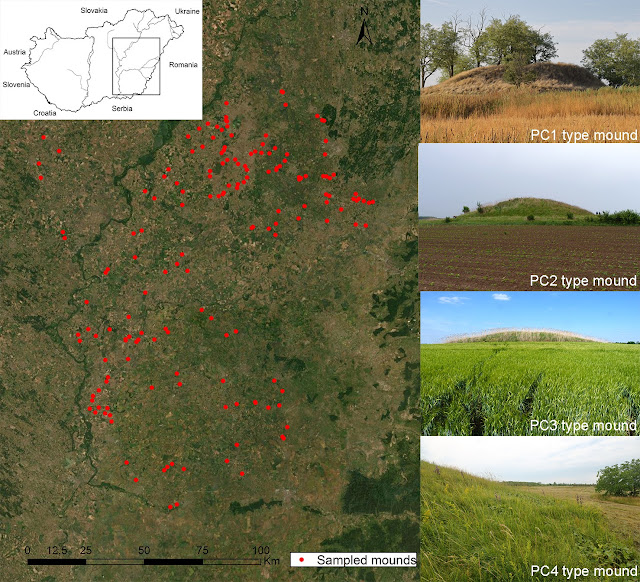
Location of the sampled 158 habitat islands in Hungary and characteristic examples of the habitat and landscape characteristics.


Sunday, 10 October 2021

Seed dispersal on cloths as a threat to protected areas: Prevention, mitigation and policy

In our new paper we give an overview on the threats of human-vectored seed dispersal in protected areas and evaluate the prevention, mitigation and policy measures that currently apply to the control of invasive alien species dispersed on human clothing.

Lukács, K. & Valkó, O. (2021): Human-vectored seed dispersal as a threat to protected areas: Prevention, mitigation and policy. Global Ecology and Conservation 31: e01851. doi: 10.1016/j.gecco.2021.e01851 [IF2020: 3.380]

The paper is open access and freely available (please click here to download). 

There are many plant species whose propagules have special morphological adaptations that supports adhesion and dispersal on mammals' fur or human clothing.

During fieldwork, hiking or other outdoor activities we often observe that propagules of several plant species are attached on our clothing or footwear. Epiantropochory is a special dispersal type, during which the propagules can achieve long-distance dispersal. Due to the increasing global population and mobility, people can act as super-effective dispersal vectors, enabling cloth-dispersed propagules to cross several geographical barriers and travel between habitats, regions or even continents. The ability for epiantropochory has been documented for almost 450 plant species so far, and with more research, this number will probably increase considerably. From the conservation viewpoint, it is important that most of the cloth-dispersed plant species are considered as weeds, and in some cases, cloth-dispersal can be a starting point for their invasion.

Long-distance transportation networks (air, water, railway and highway) are responsible for the international spread of invasive alien species and the development of tourism-related infrastructure (roads, buildings, hiking trails) increases the local spread of these problematic species within protected areas. Unintended seed dispersal on clothing and footwear can also affect those areas of the nature reserves which are not exposed to the mass invasions caused by vehicles, construction works, trade or agriculture. Due to the increasing pressure of tourism, we can expect that the importance of human-vectored seed dispersal as a threat for introducing invasive alien species will increase rapidly; which issue should be properly addressed by biosecurity measures in order to detect, control and manage the spreading of these harmful organisms.

The propagules of brome species (Bromus spp.) can be very annoying during the seed ripening season. Photo and leg of Csaba Tölgyesi :)

In our study, we collected those biosecurity measures which currently apply to the control of invasive alien species dispersed on human clothing. We also extracted relevant findings from studies on human-vectored dispersal for giving recommendations in order to improve policy measures aiming the prevention and mitigation of the spread of propagules of invasive alien species on clothing.


In this figure we summarize the most important measures of prevention, early detection and management that can be applied against the spread of invasive alien species by human-vectored seed dispersal on cloths.

Please see below the summary of the paper.

Abstract

The growing global population size and the increasing mobility of people can make humans as a potentially super-effective dispersal vector of plant propagules. Therefore, human-vectored dispersal (HVD) on clothing and footwear can be an effective way of the dispersal of invasive alien species (IAS). This can be especially problematic in protected areas, which are not exposed to the mass invasions caused by vehicles, construction works, trade or agriculture, but still exposed to HVD by tourists. In this study, we collected those biosecurity measures which currently apply to the control of IAS dispersed on human clothing. We also extracted relevant findings from studies on HVD for giving recommendations in order to improve policy measures aiming the prevention and mitigation of the spread of propagules of IAS on clothing. Even though many peculiarities of HVD are already known, e.g., retention potential of different fabric and cloth types, traits of the species of the most successful IAS dispersed by HVD and potential dispersal efficiency of HVD, we found that current IAS control measures usually do not consider and do not address sufficiently the threats represented by HVD on cloths. We suggest a number of voluntary and institutional measures that could be easily applied to decrease the chance of dispersing IAS by HVD, including information, self-regulation, legislation, quarantine measures, monitoring, interception and visitor management.

Sunday, 26 September 2021

Grassland restoration on kurgans in the Hortobágy National Park

Kurgans (ancient burial mounds built by nomadic steppic tribes) are iconic landmarks that are included in the European Landscape Convention as features characteristic of the Hungarian landscape. To maintain and highlight their landscape values, in many cases, active restoration actions are necessary. On mounds formerly ploughed or degraded, grassland restoration is a good option to increase the conservation values. This way, weed suppression and the establishment of target grassland species can be supported in a cost-effective way. Suppression of weeds can increase the landscape value of the kurgans and is also beneficial for the farmers as the suppression of weeds on the kurgan also decreases the amount of weeds in the neighbouring croplands. The established grassland species can increase the landscape-scale biodiversity, and the restored grassland patches can be essential elements of the landscape-scale network of semi-natural habitats.


The restoration team: Károly Hoffmann, Balázs Deák, Sándor Újfalusi, Sándor Borza, Orsolya Valkó, Laura Godó, Réka Kiss; and of course Fidó dog:)


Our research group, together with the colleagues of the Hortobágy National Park Directorate aimed to restore the grassland vegetation of three kurgans.

In the Álom-zug, we restored a 0.7-hectare-sized area  by sowing seeds of a fescue species (Festuca rupicola) characteristic of the loess grasslands of the region, in a density of 25 kg/ha. To make sure that the seeds are sown in the most homogeneous way, we broadcasted the seeds from two pickups that were moving in parallel. This enabled a precision sowing and gave us a very funny experience  :) 

We divided the seeds to fix portions for each sector, to make the sowing as homogeneous as possible.

Seeds of Festuca rupicola.

Measuring the portions.

We could broadcast the seeds homogeneously from the two pickups.

We also did magic :)

Seed rain :)
 
On all the three mounds we also introduced grassland specialist species by directed seeding. For this we used the soil disturbances available on the sites, e.g. fox burrows or wild boar rootings. Agropyron cristatum was sown on the top of the mounds, since in natural conditions this species often forms monodominant patches in this micro-habitat. The forb species were sown as a seed mixture into the open patches on the slopes. The seeds of forbs were collected by our research group and by the Hortobágy National Park Directorate. We used the seeds of the following species characteristic of loess grasslands: Achillea collina, Centaurea pannonica, Dianthus pontederae, Galium verum, Hypericum perforatum, Knautia arvensis, Phlomis tuberosa, Salvia austriaca, Salvia nemorosa, Scabiosa ochroleuca, Silene vulgaris and Verbascum phoeniceum. We hope that these species can establish successfully in the establishment gaps, and later they can be abundant on the kurgans.
 
Mixing of the forb seeds with soil.

 
Soil preparation by hoeing.
 
 
Soil preparation by raking.

 
Sowing of the diverse seed mixture.