Tuesday, 27 September 2022

International Meeting for PhD students in Botany in Poroszló

Between 22-25 September, we organized an International Meeting for PhD students in Botany in Poroszló, Hungary. This meeting was first initiated by Milan Chytry and Zoltán Botta-Dukát about twenty years ago, and it has a very nice tradition since then. Every second year, PhD students in botany meet somewhere in Central Europe and they share their research plans and results, and they can get advice from senior scientitst in a friendly atmosphere.

After a few years break do to the pandemics, finally this nice event could be organized in person. We were very happy that we could organize this event this year - Zoltán Botta-Dukát, Balázs Deák and Orsolya Valkó, from IEB CER Vácrátót.

There was a huge interest and we were almost 70 participants, from 16 countries :) The scientific program was very dense, but very interesting; the PhD students gave very impressive and high-quality presentations.

The venue of the conference was in Poroszló, in the Tisza-Lake Ecocentrum, which was a wonderful place for having such an event. During the (few) coffee breaks, we could visit the nice indoor and outdoor exhibitions and aquariums, which was a nice and refreshing activity. During the nights, there were two very interesting topical discussions about 'How can we translate the scientific results into practice?' and whether 'Quality or quantity counts more in science?', followed by a lively social program.

On Sunday, Balázs Deák led a half-day long excursion, where we showed the participants the natural beauties of the Hortobágy National Park, the alkaline grasslands and wetlands, loess grasslands, and of course, kurgans.


The event was supported by the Hungarian Ecological Society and the Hungarian Academy of Sciences, we are grateful for their support. We are thankful for all the participants for their enthusiasm and active participation in all the events. We are thankful for all the colleagues from IEB who helped us in the organization, especially József Nagy, Attila Lengyel and Miklós Kertész. We are thankful for the Hortobágy National Park Directorate for supporting the field trip.

Wednesday, 21 September 2022

Our 'Forefront' project received funding - our new research will start soon

Our research project was one of the ten funded Forefront projects by the National Research, Development and Innovation Office in 2022. This gives us a unique opportunity for strengthening our group and for studying our beloved research topics in the next five years. The project will start soon, from 1st October :)

The title of the project is ‘Grassland restoration based on nature-based solutions in agricultural landscapes: drivers at micro- and macro-scales’. The topic of the project aligns well to the current global and European policies, that have ambitious plans for supporting habitat restoration in agricultural landscapes. The Frontline project aims to provide a comprehensive framework for utilizing nature-based solutions in the restoration of semi-natural grasslands and in creating multifunctional agricultural landscapes. The ambition is a multi-scale and multi-site research program that by answering theoretical ecological questions provides evidence-based solutions for strategic restoration planning and for fine-tuning the agri-environmental schemes. The novelty of our work is that we will combine approaches of large-scale multi-site vegetation surveys with landscape ecology, seed ecology and historical ecology. First, we use a multi-site chronosequence approach and study the spontaneous and assisted grassland recovery in agricultural landscapes. We sample the vegetation in 300 recovering sites and evaluate diversity and species composition patterns as a function of small-scale environmental heterogeneity, landscape context and recovery time. Second, we analyze the temporal (seed bank) and spatial (seed rain) components of seed dispersal and test the effect of the local and landscape factors on the availability of seed sources. Finally, we study whether seeds from the seed sources can achieve successful establishment in the aboveground vegetation and test the importance of plant functional traits, landscape- and environmental filters in the establishment process from the seed sources in the recovery process. We aim to develop and test seed-based restoration methods for overcoming establishment limitation. The research will identify optimal settings of local and landscape factors where recovery is the most promising and support restoration prioritization by determining where we can rely on spontaneous recovery processes and where we need active restoration measures.


Tuesday, 30 August 2022

Finally, we can attend conferences :) The week in a nutshell: conferences on conservation biology, landscape ecology and archaeology

After three years, it was a real pleasure to finally attend conferences in person and to meet with colleagues who we haven't met for a long time. The last part of August was especially intensive and exciting as we attended/will attend in total four conferences :) And now we are very much looking forward to the two forthcoming conferences in Spain in September.

In a chronological order, we attended/will attend the following meetings in the past days

- European Congress for Conservation Biology, Prague: the biggest conference of the European conservation biologist community, with great talks, great symposia and of course great other programs. Balázs Deák was a member of the scientific committee and he also organized a thematic symposium entitled 'Synergy between nature and culture: the role of historical and sacred natural sites in biodiversity conservation'. This gap-filling symposium was very interesting and gave a great overview on this very important but less known topic. Besides, members of our group participated in the conference with oral presentations and speed presentations.

- Hungarian Conservation Biology Conference, Pécs: right after the European conference, we went to the Hungarian one, which had also great talks, and great programs. With Katalin Török we organized a roundtable discussion entitled 'From where to where we transfer propagules in grassland restoration?'. We had a very lively discussion about this controversiary topic. Besides, our group participated at the conference with several posters and the talk of Katalin Lukács.

- Hungarian Conference on Landscape Ecology, Nádudvar: Parallel with the above two conferences, there was another interesting Hungarian conference, on which Sándor Borza from our group participated with a presentation and a poster.

- Annual Meeting of the European Archaeological Association, Budapest: the largest European archaeological conference is also running this week. From our group, Balázs Deák and Ádám Bede will participate with one presentation and one poster each, in a section dedicated to kurgans.

Finally, some photos about our adventures in Prague :)

The symposium organized by Balázs about the synergies between nature conservation and culture.

The botanical garden of the Charles University is a hidden gem, with a very interesting exhibition of wetland and aquatic species.

We visited the famous U Fleku inn :)

In Prague, there are so many invasive nutrias. Once on an island of the Vltava river, we so as many as thirty individuals! They are not afraid at all from the tourists.

We visited the Lednice-Valtice UNESCO site both on the journey to and back from Prague. This is a great place and definitely worth a visit. Not only because the wonderful buildings and the spectacular and huge hedges, but also because there are wonderful natural habitats there, including meadows with large old trees and nice lakeshore vegetation.

Group photo at the ECCB conference :)

Sunday, 31 July 2022

Field trip and planning of a research project in the wonderful Uzbekistan

Early in this year we started emailing with researchers of the Samarkand State University, and we started to plan together a research project about the restoration possibilities of overgrazed and degraded sandy steppes and semi-deserts. After meeting in the virtual space the next step was even nicer: in July we spent ten days in Uzbekistan, visited the potential study sites in Karnap region and the Kyzyl-Kum desert and we started to plan the details of the research. Dr. Toshpulot Rajabov, the dean of the Agrobiotechnology Institute at the Samarkand State University studies the degradation states of these ecosystems after overgrazing for decades. The plan is that two of his students, Abdubakir and Nodir will come to Hungary for PhD studies and we will study together the restoration prospects of the overgrazed rangelands. 

We spent a wonderful time in Uzbekistan. It is truly a wonderful and very interesting country and the people are very friendly and welcoming.

Large part of the country are covered by such heavily grazed rangelands. For the hot summer period the vegetation is dried out and grazed.

Young herders.

For maintaining a large livestock population, a large amount of supplementary feed is often needed.

Discussion at a watering point.

The heart of the grazing systems are the watering wells. These are the most heavily used and degraded areas.

Horses are coming to the watering well.

Next to the watering well, there is the sacrificied zone, which is characterised by high level of trampling and manuring and almost no vegetation.

Beautiful but a bit too skinny horses.

After some distance from the watering well, the vegetation cover becomes larger.

A transitional vegetation in the Karnap region, here we can observe signs of degradation but also the elements of the natural rangeland vegetation.

Artemisia diffusa is the most important forage species in these rangelands.

Goats are grazing in an Artemisia-dominated pasture.

For the summer, the consumable biomass becomes very sparse - at least from this angle it looks like a very poor pasture.

From a different perspective at the ground layer we can see that still there is a considerable biomass of grasses and sedges.

Agama.

Young herders.

Iris songarica is an important indicator species of overgrazing and degradation. Now it is not as spectacular as it might be in springtime :)

Remnants of a huge camel spider.

Tosh asks a herder about the history of the area.

Young herders.

Two very similar Artemisia species: Artemisia diffusa and A. turanica. The difference is the colour of the stem.

This picture synthesises the problems with overgrazing.


The best honey melon in the world grows here in the semi-desert region of Uzbekistan. It is soo delicious, nothing like any other melon :)

This is one of the oldest buildings in Uzbekistan, situated in Tim village in the Karnap region.

The cemetery of Tim village is built around a large kurgan. We have seen several kurgans where in later ages cemeteries have been established.

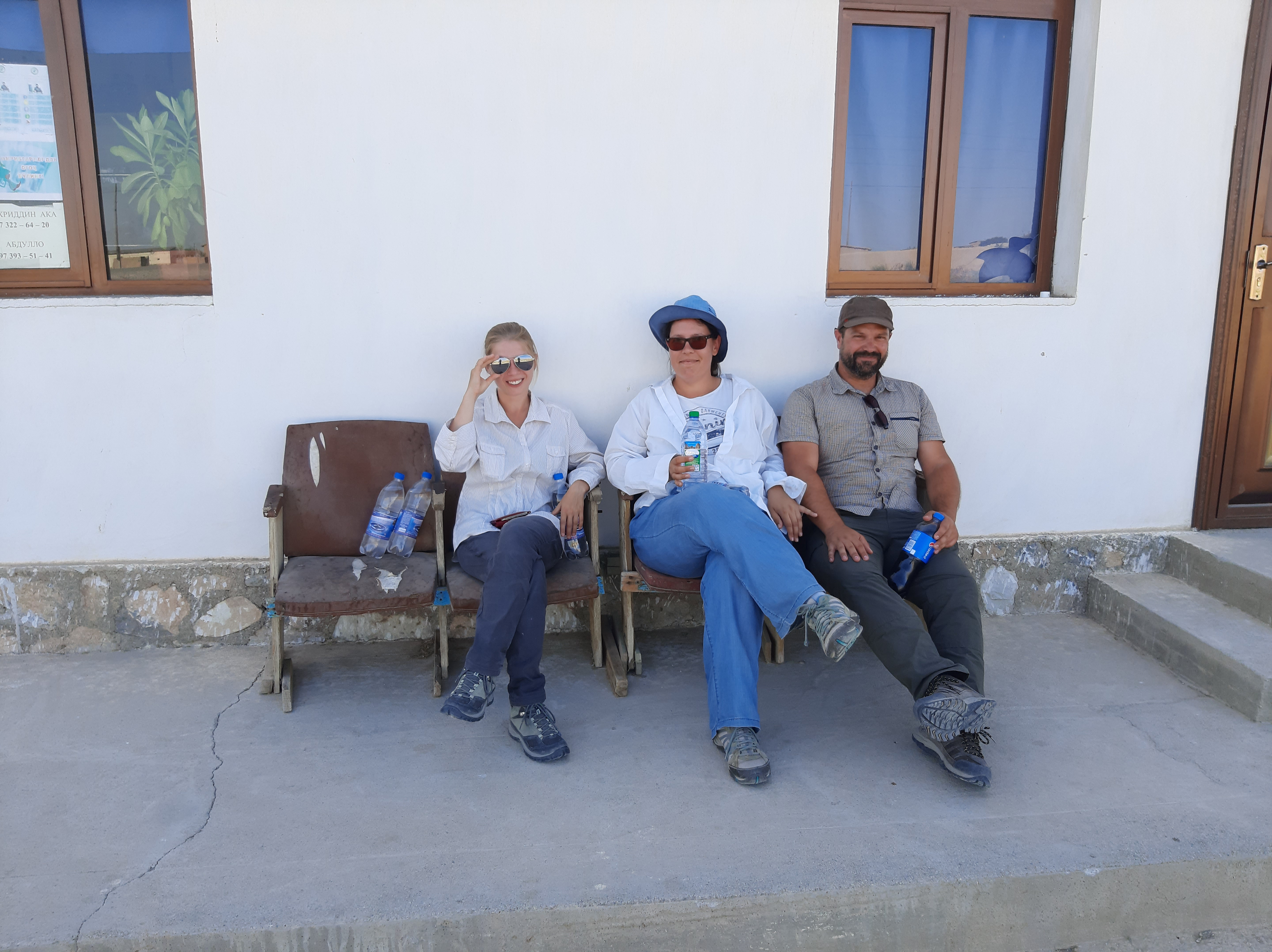
This nice bench with the shadow and cold water is like an oasis in the 47 C degrees :)

Alida and I slept in this wonderful tent in the desert. A hotel with thousand stars :)

Everywhere we went we saw many kurgans, including huge ones. Here also a cemetery was established later on the body of the kurgan.

Similar to Hungary: steppe island on a kurgan surrounded by the sea of the arable field.

It is difficult to say wheter kurgans of Rollers (Coracias garrulus) are more abundant in Uzbekistan. We saw many Rollers but only took this one distant picture. In Uzbekistan these birds usually nest in holes in such steep walls.

We visited the Zerashan nature reserve near Samarkand. Here lives one of the last populations of red deer (Cervus elaphus) in the country, which is strictly protected so we could observe the dears only behind a fence.

White-winged woodpecker (Dendrocopos leucopteros) near the Zerashan river.

A natural-like part of the Zerashan river.

Capers (Capparis sp.) and yellow starthistle (Centaurea solstitialis) on the riverbank.

Caper flower.

Common mynas (Acridotheres tristis) like to sit on the cattle.

We were quite lucky with vultures, all together we have seen five species. On this picture there is a cinerous vulture (Aegypius monachus).

Egyptian vulture (Neophron percnopterus).

Himalayan vulture (Gyps himalayensis).


A water reservoir on the way to the Zaamin Nature Reserve.

Spectacular mountains were all peace of land is grazed.

Waterfall in the Zaamin Nature Reserve.

The snowy peaks over 4000 m delineate the border between Uzbekistan and Tajikistan.

Mountain pasture in Zaamin.

Group photo at a gorgeous canyon.

Dried yogurt balls in different flavours.

Mosaic landscape in Zaamin.

During our trip, we spent most evenings in the beautiful Samarkand.

Registan

Inner courtyard in Registan.

Registan.


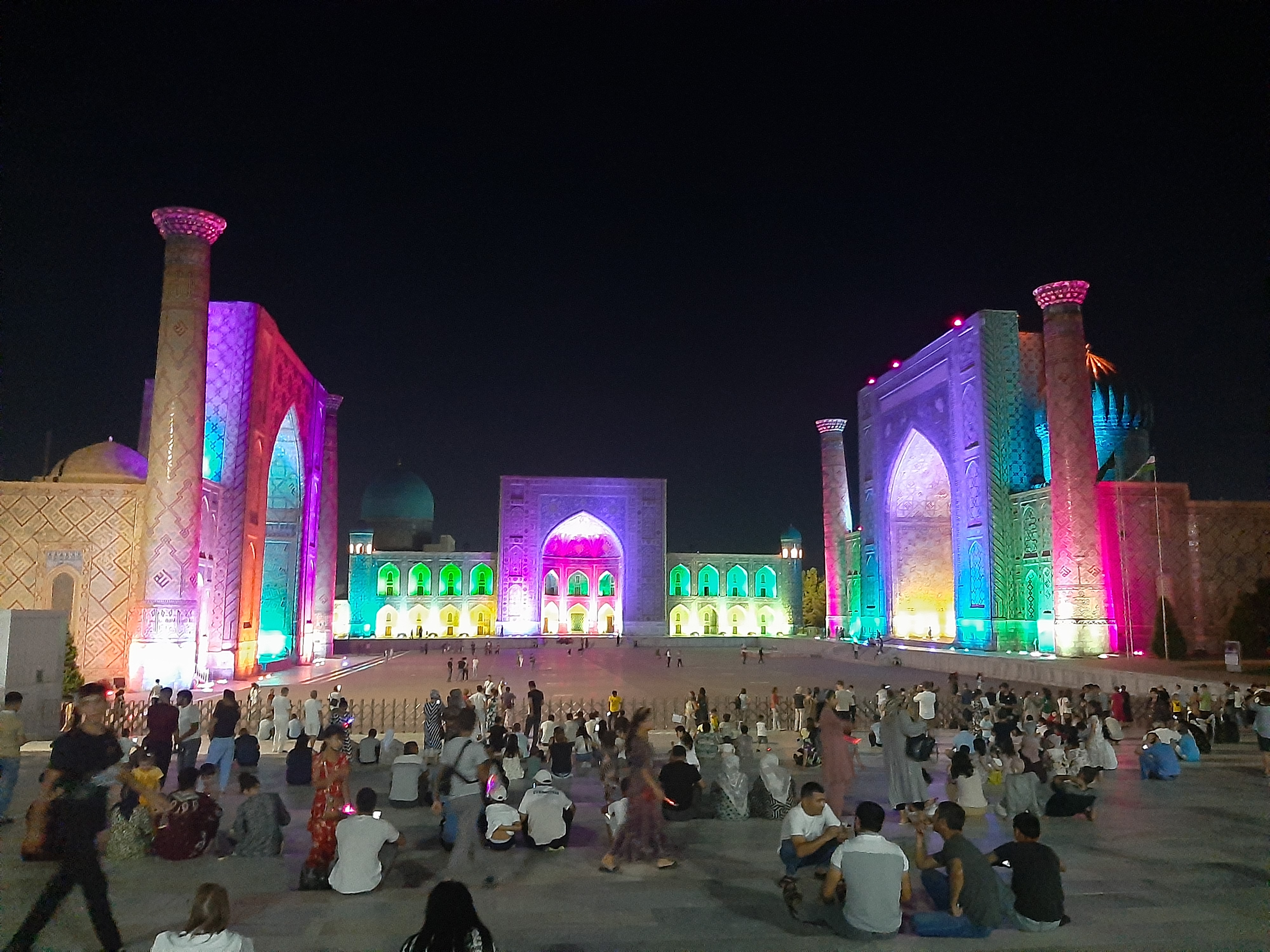
Registan at night.

Light show at Registan.

Registan in full colour.

The Bibi Khanym mosque.

Shrubs and grasses grow on the beautiful cupola.


Pedestrian street in Samarkand.

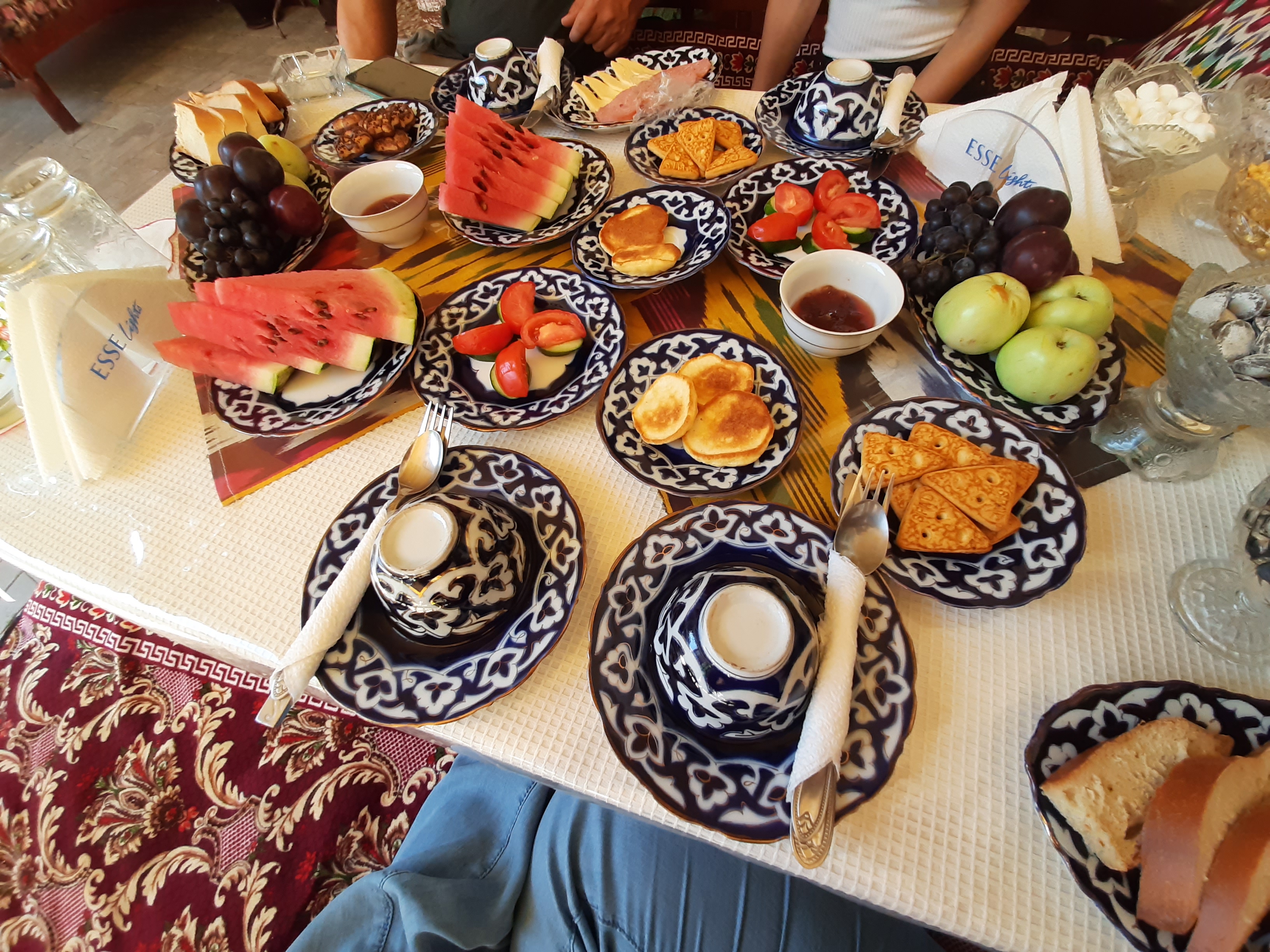
Huge and very good breakfast.

Plov: one of the national dishes.

Beautiful ceramics in the bazar of Samarkand.

Media attention at the Samarkand State University.