Monday, 15 April 2024

Ecosystem restoration with local or broad seed provenancing: our new perspectives paper in Biological Conservation

Our new perspectives paper, about the challenges related to seed provenancing in restoration has been recently published in Biological Conservation.

The paper is open access and freely available on the Journal's homepage (please click here).

The citation of the paper:

Török, Katalin, Valkó, Orsolya, Deák, Balázs (2024): Ecosystem restoration with local or broad seed provenancing: Debates and perceptions in science and practice. Biological Conservation 293: 110535. https://doi.org/10.1016/j.biocon.2024.110535 

In this perspectives article, first we describe the debate on local versus broad provenancing and the benefits and challenges related to the approaches. For this we provided an overview on the current state of the art discussing the pros and cons about local and broad scale provenancing. In order to provide a deeper insight, we compiled a stakeholder survey involving restoration and conservation experts, and practitioners related to this issue. We aimed to highlight the synergies and potential conflicts between practice and research in order to enhance future discussions and by that fine-tuning provenancing frameworks. Finally, we merged the knowledge gained from the literature with that of the stakeholder survey and proposed a simple decision support framework on provenancing in restoration. The framework considers the critical intersections of assessments and decisions, the importance of science and practice at different stages, and includes the role of stakeholders in the process.

Abstract

The UN Decade on Ecosystem Restoration gives new momentum to restoration projects worldwide, which often involve the introduction of plant species. Research evidence shows that restoration success can depend on the seed source. However, there are still debates about the pros and cons of local vs. broad provenancing in restoration. Despite a general agreement on the need for seed transfer regulation, the debate on provenancing challenges or delays the implementation of restoration. In this perspective article, we highlighted this debate that often creates a bottleneck and also examined this issue by surveying the opinion of Hungarian restoration ecologist researchers, conservation practitioners working in restoration, and other conservation experts on the perception of local vs. broad provenancing and the prioritization of further research versus immediate action. Researchers and practitioners had markedly different attitudes; defining aims and prioritization, using genetic knowledge, and species focus were most important to researchers, while broad provenancing,  feasibility, and rapid action were prioritized by practitioners. Comparison of the views of the stakeholders and linking this to a decision framework is a novelty of the study, a step necessary to understand the perception of each other to cooperate for a successful restoration. The results reflect reactive vs. proactive antagonism that should be discussed to identify which approach can be beneficial for restoration and feasible on the given scale. What is needed is to dive into restoration  implementation, jointly find bottlenecks, such as seed sourcing, and solve the problems by using the best available knowledge and necessary compromises.

Monday, 18 December 2023

Ecologists and hikers have a major role in seed dispersal - Our new paper in the Science of the Total Environment

Long-term dispersal of diaspores (seeds, fruits) is ensured by seed dispersal vectors, such as wind (anemochory), water (hydrochory) and animals (epi- and endozoochory). Nowadays, one of the most effective seed dispersal vectors are humans. The key our efficiency is the rapidly growing rate of global transport, trade and tourism, which enables us to move more and more easily and quickly between distant biogeographical regions, and even between continents. People can travel large distances in a short time (even from one continent to another) and connect areas that would otherwise have no connection.

Seed dispersal on clothing (epianthropochory) can be considered a special form of epizoochory. This type of dispersal can be very important from a conservation point of view. Based on the results of studies so far, nearly 500 species have been registered to be able to spread on clothing. Most of these plants are weed and invasive species that cause serious conservation problems, especially in the isolated habitats.

An extreme case of epianthropochory :)
 

In our study, first-authored by Katalin Lukács and published in the journal Science of the Total Environment, we analysed the potential mechanisms that might affect the outcome of seed dispersal on clothing.

Our research involved 88 volunteers in a multi-site field experiments with samples collected from Hungary, Romania, and the Czech Republic. We accompanied volunteers on 39 sampling occasions during fieldwork or filed trips and provided each participants a new pair of socks at the beginning of the day. At the end of the outdoor activity, we collected the seeds from socks. We also collected seeds from the inside and outside of volunteers’ shoes (a total of 251 samples and 2,008 subsamples were collected). During the experiment, we also registered the sampling date, distance walked, and time spent outside, a list of plants to characterise the species pool of the visited site and the participants’ clothing type. The field experiment was complemented by a questionnaire survey to assess the people’s habits that might be relevant to the dispersal process under study.


The process of sample collection and sample processing.

Our results show that dispersal on clothing can play an important role in seed dispersal between habitats and regions. The process allows the spread of many species: we have found nearly 36,000 seeds from nearly 230 plant species. Interestingly, most seeds were spread by men and field biologists during visits to grassland habitats. On the shoes and socks of the most efficient dispersers we occasionally found more than 2,000 seeds. The type of clothing and footwear also had a significant effect on the dispersal efficiency: wearing long pants and high-top shoes can decrease seed dispersal potential compared to wearing short pants and low-top shoes (e.g., sneakers).

Based on the results of the study, we highlight the complexity of the process of seed dispersal on clothing. Informing people about this phenomenon is crucial, as our individual habits and behaviour can reduce the spread of weeds and invasive plant species.


Citation of the paper:


Lukács, K., Tóth, Á., Kiss, R., Deák, B., Rádai, Z., Tóth, K., Kelemen, A., Bátori, Z., Hábenczyus, A.A., Tölgyesi, C., Miglécz, T., Godó, L., Valkó, O. (2024). The ecological footprint of outdoor activities: Factors affecting human-vectored seed dispersal on clothing. Science of the Total Environment 906: 167675. 

The article is open access and can be freely downloaded from the journal homepage (please click here).

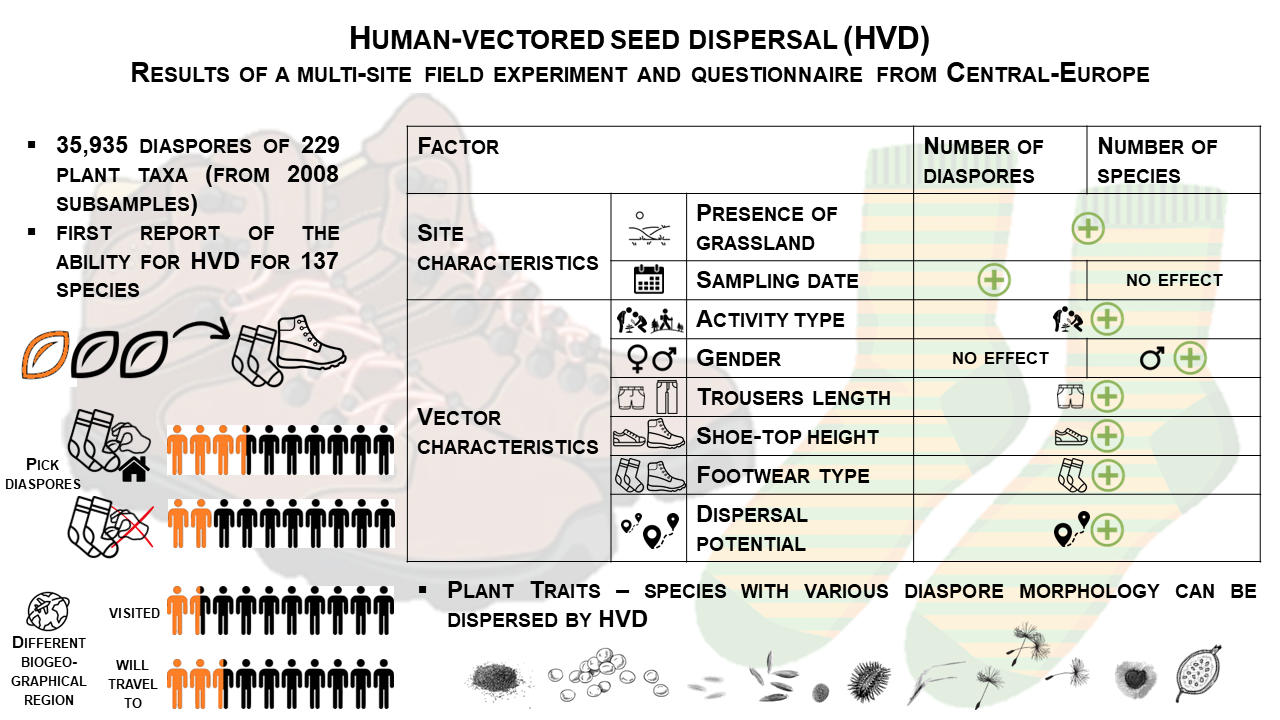
We summarized the results in a graphical form in this graphical abstract:


Abstract


In the Anthropocene, humans are among the most abundant long-distance seed dispersal vectors globally, due to our increasing mobility and the growing global population. However, there are several knowledge gaps related to the process of human-vectored dispersal (HVD) on clothing. In a multi-site field experiment covering various habitat types in three countries of Central-Europe, we involved 88 volunteer participants and collected 251 HVD samples and 2008 subsamples from their socks and shoes. We analysed the number of diaspores and species in the samples. Specifically, we studied the effects of site characteristics (variables related to habitat types and season), vector characteristics (activity type, gender, clothing type, shoe type) and plant characteristics (species pool of the visited habitats and plant traits) on the number of diaspores and array of species dispersed. We assessed the habits of people that could be relevant for HVD with a questionnaire survey. A total of 35,935 diaspores of 229 plant taxa were identified from the samples, which indicates a huge potential of HVD in dispersing diaspores across habitats and regions. Most diaspores were recorded in grassland habitats, and more diaspores were dispersed during fieldwork than excursions. Clothing type also played a decisive role: there were more diaspores and species when wearing short-top shoes and short trousers than long ones. Even though our study was carried out mainly in natural or semi-natural habitats, a large number of dispersed species were disturbance-tolerants and weeds and only a few were specialists, suggesting the controversial role of HVD in conservation. At the individual level, people can reduce the number of diaspores through their clothing choices and diaspore removal habits, while providing adequate equipment for staff, operating cleaning stations, and increasing awareness of employees are main ways in which unintended diaspore dispersal can be tackled at the institutional level.

Thursday, 27 July 2023

The legacy of ancient civilizations can support biodiversity conservation - Our new paper in Conservation Biology

Our newest paper about the importance of cultural values in the conservation of steppe grasslands has recently been published in Conservation Biology.

Deák, B., Bede, Á., Rádai, Z., Dembicz, I., Apostolova, I., Batáry, P., Gallé, R., Tóth, C.A., Dózsai, J., Moysiyenko, I., Sudnik-Wójcikowska, B., Zahwatowicz, M., Nekhrizov, G., Lisetskii, F., Buryak, Z.A., Kis, S., Borza, S., Godó, L., Bragina, T.M., Smelansky, I., Molnár, Á., Bán, M., Báthori, F., Árgay, Z., Dani, J., Kiss, R., Valkó, O. (2023): Contribution of cultural heritage values to steppe conservation on ancient burial mounds of Eurasia. Conservation Biology https://doi.org/10.1111/cobi.14148

Ancient burial mounds built in historical times are not only important monuments of our historical heritage, but also act as refuge for steppe habitats and species. Despite their small size they often act as biodiverse spots in the landscape even though the landscape has been transformed to croplands or urban areas.

In our recent paper published in Conservation Biology we aimed to shed light on the connection of cultural values and biodiversity present on the mounds. For this we used a dataset containing more than one thousand kurgans distributed from Hungary to Mongolia.

We found that the conservation potential of the kurgans was highly supported by cultural values confined to the kurgans (such as ancient statues, medieval border marks, small churches, crosses or old cemeteries) that were important for the local communities. By protecting and maintaining cultural values people prevent intensive land use, and also ensure an extensive management for the grasslands on the mounds. By that indirectly they also maintain steppe habitats and species. This kind of protection is provided by the own willingness of the people (no legislative restrictions are needed), thus can be maintained in a sustainable way for a long time. This kind of protection connected to the presence of cultural values is especially important in intensively used landscapes, where the proportion of nature conservation reserves is extremely low. In these unprotected landscapes kurgans with cultural values can act as little steppe islands in the sea of the vast croplands.

Our paper can be accessed here.
And you can read a very interesting article published in the Anthropocene Magazine about our study.

Monumental statue and species-rich dry grassland on the Nagysándor-kurgan in Debrecen.

Abstract

Civilizations, including ancient ones, have shaped the global ecosystems in many ways through a co-evolution of landscapes and humans. However, the cultural legacies of ancient and lost civilizations are rarely considered in the conservation of the Eurasian steppe biome. Here using a dataset containing more than 1,000 data records on localities, land cover, protection status, and cultural values related to ancient steppic burial mounds (so-called ‘kurgans’), we evaluated how these iconic and widespread landmarks can contribute to grassland conservation in the Eurasian steppes, which is one of the most endangered biomes on Earth. Using Bayesian logistic generalized regressions and proportional odds logistic regressions, we aimed to reveal the potential of mounds in preserving grasslands considering landscapes with different levels of land use transformation. We also compared the conservation potential of mounds located inside and outside protected areas and assessed whether the presence of cultural values supports the maintenance of grasslands on them. We revealed that kurgans are of great importance in preserving grasslands in transformed landscapes outside protected areas, where they can act as habitat islands that contribute to habitat conservation and improve habitat connectivity. We found that in addition to the steep slopes that hinder ploughing, the existence of cultural values could almost double the chance of grassland occurrence on kurgans due to the extensive land use related, and the respect of local communities. As the estimated number of steppic mounds is about 600,000 and similar historical features exist in all continents, our results can be upscaled to a global level. Our results also suggest that an integrative socio-ecological approach in conservation might support the positive synergistic effects of conservational, landscape, and cultural values.

Wednesday, 19 July 2023

Seed Biology conference in Paris

The ISSS (International Society for Seed Science) international conference was recently held in Paris at the Sorbonne University. Seven members of our research group attended the event and presented seven posters.


We presented the following posters at the conference:

Sándor Borza et al.: Conservation values, ecosystem services, and disservices related to a large iconic bird species

Balázs Deák et al.: Establishment gaps in species-poor grasslands: sowing diverse seed mixtures and small-scale sward disturbance support the colonization of target species

Laura Godó et al.: Owl-mediated diploendozoochorous seed dispersal increases dispersal distance and supports seedling establishment

Réka Kiss et al.: Timing seed-sowing of grasses and forbs can support grassland restoration

Katalin Lukács et al.: Human-vectored seed dispersal: A potential threat to the flora of protected areas

Ágnes Tóth et al.: Vertical distribution of soil seed bank and the ecological importance of deeply buried seeds in alkaline grasslands

Orsolya Valkó et al.: Laundry washing can increase the dispersal efficiency of cloth-dispersed seeds.


With the conference, we visited the beautiful Vaux le Vicomte Castle.

Wildflower patch for pollinators in the centre of Paris in the Jardines des Plantes.

Friday, 14 July 2023

Our new review paper about the challenges and opportunities of grassland restoration on roadsides

In our latest article, we look at a special case of grassland habitat restoration: roadside verges.

Valkó, O., Fekete, R., Molnár V., A., Halassy, M., Deák, B. (2023): Roadside grassland restoration: Challenges and opportunities in the UN decade on ecosystem restoration. Current Opinion in Environmental Science and Health 34:100490. https://doi.org/10.1016/j.coesh.2023.100490

The article is open access and can be downloaded from the journal homepage.

Why is grassland restoration important on roadsides? The global road network is more than 64 million km long and growing, with road verges occupying nearly 1% of the land area of developed countries. These are vast areas that are generally not suitable for industrial, agricultural, or other uses, and can provide opportunities for habitat restoration and establishing ecological corridors. The ideal situation for road managers is to establish a low-input, low-maintenance, permanent vegetation adapted to the habitat conditions on the roadside. In many biogeographical regions, roadside verges can provide suitable habitat for drought-tolerant grassland species native to the region, so a well-designed grassland restoration can be an ideal solution from both a conservation and a road management perspective. In the article, we highlight the synergies between these two approaches and the opportunities and constraints of grassland restoration in roadsides with native species. The specific habitat conditions of roadside verges and how grassland restoration on roadside verges differs from other grassland management interventions are discussed. We compare the success of seeding with commonly used commercial seed mixtures and with seed mixtures of native species, and suggest criteria for the selection of appropriate plant species, as well as key research areas to be investigated in the future.

Special characteristics of roadside environments. Photo credits: Attila  Molnár V. (A-G), Szabolcs Kis (H) and Réka Fekete (I)

Abstract

Restoring near-natural grasslands on roadsides is an excellent opportunity to support native biodiversity and provide ecosystem services that benefit the safety and functionality of road networks. Although several best practices and case studies are available on biodiversity-friendly roadside revegetation measures, their application is quite scarce, and, in practice, ecological aspects are rarely considered. To restore and preserve diverse and native roadside vegetation, we suggest (1) facilitating discussion, cooperation, and knowledge transfer between ecologists and agencies responsible for roadside vegetation management, (2) prioritizing the use of native plant species in roadside restoration and revegetation, as well as increasing regional capacities for native seed production, (3) supporting the application of biodiversity-friendly management practices of roadside vegetation, and (4) inventorying and conserving remnant semi-natural roadside grasslands.


Saturday, 10 June 2023

Owl-mediated secondary seed dispersal: Our new paper in GECCO

Our new paper by Laura Godó & Sándor Borza et al. about owl-mediated secondary seed dispersal has recently been published in GECCO.

Godó, L. & Borza, S., Valkó, O., Rádai, Z., Deák, B. (2023): Owl-mediated diploendozoochorous seed dispersal increases dispersal distance and supports seedling establishment. Global Ecology and Conservation 45: e02519. https://doi.org/10.1016/j.gecco.2023.e02519  [IF2021: 3.969] 

The paper is open acccess and can be freely downloaded from the journal homepage (please click here).

We studied a very interesting dispersal system: we studied the seed content and the prey items in the pellets of the Barn Owl (Tyto alba) and evaluated the effect of the pellet material on the establishment.


Abstract

Seed dispersal is an essential process contributing to the maintenance of plant populations. Zoochory is a widespread way of plant dispersal in every terrestrial ecosystem that can ensure the long-distance dispersal of seeds. Secondary seed dispersal (SSD) by far-ranging raptors is a special type of zoochory, which might have a role in colonizing new habitats. We used the barn owl (Tyto alba) as model species to test the effectivity and seasonality of SSD in open semi-natural landscapes. We collected 582 pellets from six sites in East-Hungary throughout one year. We identified prey items in the pellets and determined the viable seed content of the pellets by germination experiments. We found that herbivorous Microtus arvalis L. was the most abundant prey item through which most of the seeds spread. Owls dispersed the seeds of generalist and disturbancetolerant plants, indicating the habitat type where small mammals occur abundantly. In another experiment we tested the effect of the pellet material on the seedling survival and found that prey remains enhanced establishment of seedlings. Our study suggests that SSD by barn owl is occasional but important event in long-distance seed dispersal. Since the studied owl species uses several habitat types and has larger mobility than the rodents, the revealed dispersal mechanism can considerably increase seed dispersal distance and seed exchange between habitat types.

Wednesday, 24 May 2023

Toponym diversity can support vegetation naturalness: Our new paper in People and Nature

Our new paper about the connections between cultural diversity and vegetation naturalness has recently been accepted in People and Nature.

Valkó, O., & Bede, Á., Rádai, Z., Deák, B. (2023): ‘Sense of place’ and conservation: Toponym diversity helps to maintain vegetation naturalness. People and Nature https://doi.org/10.1002/pan3.10476 [IF2021: 7.500]

The paper is open access and freely available on the journal homepage (please click here).

 Giving a name is a fundamental way of recognizing and identifying a place. Place names (toponyms) are an important part of cultural diversity and reflect the cultural importance of a place. Little is known about whether the diversity of toponyms (ie the number of names given to a specific place) has an influence on human-nature relationships and the decisions of humans on how to use certain parts of the landscape. To investigate this question, we combined approaches from social sciences and ecology in a comprehensive multidisciplinary survey of 1,521 cultural landscape features in Hungary.

The landscape features studied were ancient millennia-old burial earthen mounds built by nomadic steppic tribes. Today the mounds often hold the last remnants of grassland vegetation and provide safe havens for grassland specialist plant and animal species in the intensively used agricultural landscapes of Eurasia. In our research, we compiled a comprehensive database of the mounds in the 5,150 km2-sized study region and by using various written sources, we collected all toponyms of the mounds recorded since the 18th century. We also visited all the mounds in a field survey and evaluated the naturalness degree of their vegetation, which ranged from favorable (covered by grasslands of high conservation value) to degraded (covered by degraded non-crop vegetation), transformed (ploughed), and destroyed.

We found that despite the intensive landscape transformation in the region, and independently of topographical factors (ie height of the mound, distance from the nearest settlement), a higher number of toponyms per mound was associated with a higher degree of naturalness of the vegetation. This result is especially interesting, as in the studied intensively used agricultural landscape, cultural recognition of the mounds has eroded considerably in the past centuries, but its effect is still noticeable. We believe that revitalizing public recognition of place names could enable effective and meaningful communication about cultural ties to particular landscape elements. In a broader sense, our results highlight that reestablishment of the lost cultural connections between people and nature can contribute to reversing the deterioration.

Ludas-halom mound had the highest number of toponyms - as many as twenty! Photo: Ádám Bede.